Key Points:
- Why is Japan seeking expanded access to American cybersecurity AI models?
- How have negotiations between Japan, Anthropic, and OpenAI developed since May?
- What impact did United States regulatory orders have on Japan’s AI access?
- What additional governance controls limit international access to frontier models?
- Background of U.S.-Japan AI Cooperation and Cybersecurity Policy
- Critical Infrastructure Operators and International Tech Governance
- Expanded Model Access Request: The Japanese government has formally called on leading United States artificial intelligence developers Anthropic and OpenAI to grant increased access to high-capability cybersecurity AI models.
- Critical Infrastructure Focus: Tokyo plans to encourage the use of these specialized models by operators of essential national infrastructure to identify and patch system vulnerabilities before malicious actors can exploit them.
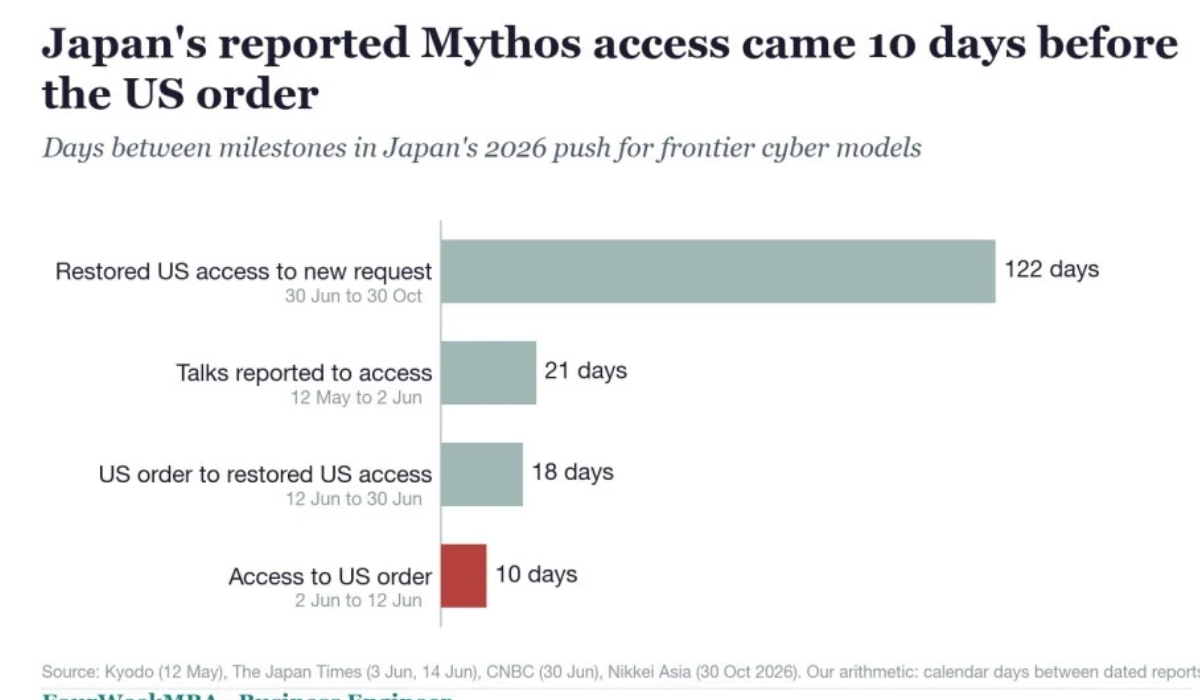
- Timeline of Negotiations: The request follows months of bilateral movement, coming 171 days after initial reports emerged on 12 May regarding Japan’s negotiations with Anthropic.
- Impact of Executive Restrictions: Japan and major domestic banks briefly secured access to Anthropic’s Claude Mythos in early June, approximately 10 days before a 12 June U.S. executive order suspended access for all foreign nationals.
- Regulatory Governance Controls: The request comes amid tightening oversight, following September reports that the White House requires U.S. government evaluation before foreign allies can access advanced frontier AI models.
Japan (Japan Daily News) October 30, 2026 – The Japanese government has formally requested expanded access to advanced artificial intelligence models developed by United States AI leaders Anthropic and OpenAI to strengthen the nation’s defensive cybersecurity capabilities. Under the strategy, Japanese authorities intend to deploy these specialized frontier tools to identify technical vulnerabilities across critical domestic infrastructure and financial networks. The renewed push comes 171 days after initial bilateral discussions were disclosed in May, reflecting Tokyo’s determination to integrate cutting-edge AI defenses amid shifting U.S. regulatory frameworks and foreign access restrictions.
Why is Japan seeking expanded access to American cybersecurity AI models?
As reported by staff writers of Nikkei Asia, the Japanese government has called on U.S. artificial intelligence developers Anthropic and OpenAI to provide greater institutional access to advanced models specifically engineered to uncover cybersecurity weaknesses. Nikkei Asia noted that Japanese officials plan to encourage the deployment of these tools by operators of essential infrastructure to shield public utilities, transport networks, and financial systems against increasingly automated cyberattacks.
The structural push by Tokyo spans both leading U.S. artificial intelligence laboratories. The current initiative builds on months of diplomatic and corporate engagement aimed at securing early access to defensive frontier models capable of conducting automated vulnerability detection and patch verification at scale.
How have negotiations between Japan, Anthropic, and OpenAI developed since May?
The timeline of Japan’s engagement with American AI developers highlights a months-long effort to secure advanced defensive software. As reported by Kyodo News on 12 May, government sources confirmed that the Japanese government was negotiating directly with U.S. artificial intelligence firm Anthropic to obtain access to its latest AI model. Kyodo News noted that the talks were driven by growing concerns within Tokyo regarding potential cyberattacks leveraged by foreign adversaries using sophisticated AI tools.
Following those initial reports, Kyodo News reported on 21 May that OpenAI had stated it would provide the Japanese government and select domestic corporations with an AI model featuring advanced cybersecurity capabilities.
Further details regarding the implementation emerged shortly thereafter. As reported by staff writers of The Japan Times on 3 June, the Japanese government and the country’s primary financial institutions had successfully secured access to Anthropic’s Claude Mythos model. Major commercial banking institutions, including MUFG Bank, Mizuho Bank, and Sumitomo Mitsui Banking Corporation, were included in the access rollout. The Japan Times additionally reported that OpenAI Chief Operating Officer Jason Kwon had promised several Japanese financial institutions access to “GPT-5.5-Cyber,” described as OpenAI’s latest frontier AI model built specifically for defensive operations.
What impact did United States regulatory orders have on Japan’s AI access?
Despite securing early operational access in early June, Japan’s utilization of advanced U.S. models was abruptly interrupted by shifts in American trade policy. As reported by staff writers of The Japan Times on 14 June, Anthropic disabled access to its most advanced artificial intelligence systems, including Claude Mythos, following an unprecedented executive order issued by the Trump administration on 12 June. The executive directive instructed U.S. technology providers to restrict the technology from foreign nationals.
Based on reporting timelines, Japan’s initial operational access to Claude Mythos in early June lasted approximately 10 days before the 12 June executive order took effect.
Restoration of access occurred gradually through vetted federal framework programs. As reported by Megan Graham of CNBC on 30 June, Anthropic confirmed it had restored access to Mythos 5 for select organizations following explicit U.S. government approval. CNBC noted that Anthropic stated it would “continue to work with the U.S. government to expand access to Mythos 5 for more domestic and international partners through its Glasswing program”. This partial restoration of access reported on 30 June occurred 18 days after the initial U.S. order and 122 days prior to Nikkei’s 30 October reporting.
What additional governance controls limit international access to frontier models?
International deployment of dual-use artificial intelligence tools remains subject to strict regulatory oversight by Washington. As reported by Ellen Nakashima and John Sakellariadis of Politico on 24 September, the White House requested that OpenAI and Anthropic withhold their newest artificial intelligence models from foreign testing entities—including the United Kingdom’s AI Security Institute—until those models complete rigorous safety evaluations conducted directly by the U.S. government.
Politico added that Anthropic withheld its Claude Mythos 5.1 model from the UK’s testing body, stating that the release was “only available to a set of U.S. organizations”. In an official blog statement cited by Politico, Anthropic clarified: “We’re coordinating with the U.S. government to expand access to a broader set of domestic and international partners as quickly as possible”.
These regulatory guardrails underscore that access to advanced cybersecurity capabilities—such as automated exploitation tools and source-code analysis tiers—remains tightly controlled under U.S. national security evaluations before international distribution is permitted.
Background of U.S.-Japan AI Cooperation and Cybersecurity Policy
The effort by Tokyo to acquire advanced U.S. AI models sits at the intersection of economic security and national defense within the Indo-Pacific region. Over the past three years, the Japanese government has prioritized modernizing its domestic digital defenses, establishing specialized units within the Ministry of Defense and the National center of Incident readiness and Strategy for Cybersecurity (NISC).
Historically, Japanese critical infrastructure operators—spanning telecommunications, power grids, rail networks, and major banking institutions—have faced growing volumes of automated cyber reconnaissance and zero-day exploitation attempts. Because proprietary frontier AI models like Claude Mythos and GPT-5.5-Cyber possess advanced capabilities for autonomous threat hunting and code auditing, obtaining access to these tools has become a strategic imperative for Tokyo.
However, because these dual-use AI systems can theoretically be weaponized to discover and execute cyber intrusions, the United States government has increasingly treated frontier AI models as restricted export technologies. The introduction of federal vetting frameworks, such as Anthropic’s Glasswing program and White House safety pre-screenings, reflects an emerging regulatory doctrine where allied access to advanced AI is granted contingent upon strict security clearances and bilateral verification protocols.
Critical Infrastructure Operators and International Tech Governance
The request by Japan for expanded access to Anthropic and OpenAI models is expected to accelerate the formalization of allied framework agreements for dual-use artificial intelligence technologies.
For Japanese infrastructure operators and financial megabanks, securing structured institutional access will likely result in the rapid integration of AI-driven vulnerability auditing across domestic networks. Major institutions such as MUFG, Mizuho, and Sumitomo Mitsui Banking Corporation will be able to automate continuous threat detection, allowing IT defense teams to remediate complex software vulnerabilities far faster than traditional manual auditing permits.
Conversely, if the U.S. government maintains stringent export controls or delays foreign distribution approvals through lengthy safety evaluations, Japanese enterprise networks may experience operational bottlenecks in deploying real-time defenses.
More broadly, this development is expected to set a legal and diplomatic precedent for how the United States shares dual-use AI infrastructure with key strategic allies. Industry analysts anticipate that Washington will establish standardized bilateral “cyber AI clearance” protocols, effectively creating an exclusive tier of allied nations permitted to utilize advanced American AI models for national defense and critical infrastructure protection.