Key Points
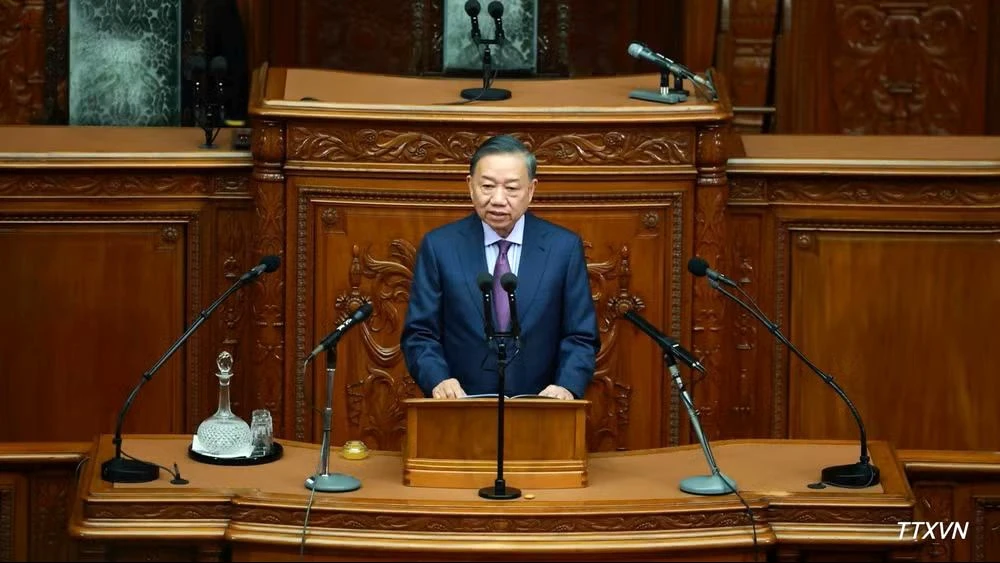
- Strategic Policy Address: General Secretary of the Communist Party of Vietnam Central Committee and State President To Lam delivered a major policy address to Japan’s National Diet in Tokyo, outlining five strategic priorities to elevate the Vietnam-Japan Comprehensive Strategic Partnership.
- Core Pillar Focus Areas: The proposed priority framework centers on technological innovation, resilient green growth, regional peace and security, society-to-society connectivity, and enhanced legislative cooperation.
- Historic Financial Benchmarks: Bilateral trade surpassed $50 billion for the first time in 2025, alongside cumulative Japanese registered direct investment in Vietnam exceeding $80 billion, positioning Japan as Vietnam’s primary Official Development Assistance (ODA) donor.
- High-Tech and Supply Chain Integration: The proposal prioritizes joint advancement in artificial intelligence (AI), semiconductor supply chains, space, marine technology, and critical mineral processing.
- Demographic and Labour Foundations: Over 100 municipal cooperation agreements and a diaspora of nearly 700,000 Vietnamese living, studying, and working in Japan form the core social foundation of bilateral ties.
Japan (Japan Daily News) November 9, 2026 – Vietnam and Japan have entered a crucial phase of bilateral integration as top Vietnamese leader To Lam called for a comprehensive upgrade in economic, technological, and security cooperation during a historic address to the National Diet in Tokyo. As reported by diplomatic correspondents for VOV.VN and Jiji Press, General Secretary and State President To Lam proposed five strategic priorities to advance the Vietnam-Japan Comprehensive Strategic Partnership, emphasizing joint development in artificial intelligence, semiconductor supply chains, and green infrastructure. The policy speech, delivered during an official state visit hosted by Japanese Prime Minister Takaichi Sanae, links Vietnam’s 2045 high-income industrial goals with Japan’s regional economic resilience strategy.
- What Are the Five Strategic Priorities Proposed by Top Leader To Lam?
- How Will Vietnam and Japan Collaborate on AI and Semiconductor Supply Chains?
- How Does the Priority Plan Address Green Growth and Supply Chain Resilience?
- What Role Will Maritime Security and ASEAN Connectivity Play in the Partnership?
- How Are Human Capital and Societal Ties Being Prioritised?
- Background of the Particular Development After the News
- How This Development Can Affect Tech Enterprise Executives, Industrial Investors, and Skilled Workers
What Are the Five Strategic Priorities Proposed by Top Leader To Lam?
According to reporting published by VOV.VN, General Secretary and State President To Lam outlined a structured blueprint designed to take advantage of 53 years of formal diplomatic relations between Vietnam and Japan.
The Vietnamese leader told parliamentarians at the National Diet that deep global economic volatility, strategic competition, and climate disruptions require both nations to strengthen their self-reliance while deepening mutual trust.
As detailed in VOV.VN’s coverage, the five strategic priorities focus on:
- Knowledge, Technology, and Innovation: Developing new growth drivers through direct collaboration between universities, research institutes, and enterprises across both nations.
- Resilience and Green Growth: Building transparent, flexible supply chains and accelerating the green energy transition while optimizing Japanese Official Development Assistance (ODA).
- Regional Peace and Security: Supporting a rules-based Indo-Pacific order, enhancing maritime law enforcement, and maintaining regional stability.
- People-Centred Social Ties: Protecting and developing human capital, improving labour dispatch frameworks, and promoting societal exchanges.
- Legislative and Policy Alignment: Strengthening parliamentary oversight, lawmaking exchanges, and operational follow-through on bilateral commercial commitments.
As reported by Jiji Press, To Lam emphasized to Japanese lawmakers that the development of each nation must serve as a catalyst for the other’s progress, creating tangible economic benefits for both populations.
How Will Vietnam and Japan Collaborate on AI and Semiconductor Supply Chains?
According to reporting by Jiji Press, science, technology, and digital transformation were identified as the primary engines for Vietnam’s next stage of national economic growth, with Japan framed as an indispensable strategic partner.
To Lam urged both nations to build joint technical capabilities in critical technological domains:
- Semiconductor Integration: Coordinated initiatives between Japanese microelectronics firms and Vietnamese engineering institutes to train specialized talent, address manufacturing bottlenecks, and push domestic enterprises further up global tech value chains.
- Artificial Intelligence Applications: Joint deployment of AI tools across healthcare, emergency disaster response, education, and manufacturing, coupled with strict data security frameworks and public accessibility.
- Advanced Research Networks: Utilizing institutional bridges like the Vietnam-Japan University to expand researcher, lecturer, and student exchange programs alongside private-sector internships.
- Small and Medium Enterprise (SME) Upgrading: Assisting Vietnamese tier-one and tier-two suppliers to meet Japanese quality compliance, management standards, and intellectual property protections.
As reported by VOV.VN, the strategy seeks to pair Japan’s advanced research capabilities with Vietnam’s rapidly expanding engineering workforce.
How Does the Priority Plan Address Green Growth and Supply Chain Resilience?
According to coverage by VOV.VN, the second pillar of the proposal focuses on building sustainable, shock-resistant economic infrastructure capable of weathering global logistics disruptions.
The framework prioritizes concrete cooperation in energy security, resource management, and development assistance:
- Green Energy Transition: Joint ventures in industrial energy efficiency, renewable power generation, grid transmission, energy storage systems, and commercially viable carbon-reduction technologies.
- Critical Minerals Processing: Partnership in resource development that prioritizes high-value domestic processing, technology transfer, and environmental recycling over raw material extraction.
- Reformed ODA Utilization: Streamlining Japanese ODA deployment to ensure infrastructure projects are evaluated on long-term operational performance, fiscal transparency, and direct public benefit.
- Multilateral Economic Alignment: Leveraging the Comprehensive and Progressive Agreement for Trans-Pacific Partnership (CPTPP) and coordinating ahead of Vietnam hosting APEC 2027 to uphold open trade rules.
As reported by VOV.VN, To Lam stated that raw material processing must safeguard domestic industrial capacity while establishing stable material inputs for Japanese manufacturing hubs.
What Role Will Maritime Security and ASEAN Connectivity Play in the Partnership?
As reported by Jiji Press, To Lam reaffirmed Vietnam’s support for the Free and Open Indo-Pacific (FOIP) vision, aligning it with the ASEAN Outlook on the Indo-Pacific and international legal frameworks.
The defense and regional stability provisions presented to the Diet highlight several security objectives:
- Maritime Law Enforcement: Expanding operational coordination in maritime security, search-and-rescue protocols, and marine environmental preservation.
- Adherence to International Law: Emphasizing the peaceful resolution of maritime disputes in accordance with the 1982 United Nations Convention on the Law of the Sea (UNCLOS) to ensure uninterrupted shipping lanes.
- ASEAN Centrality: Reinforcing the ASEAN Community Vision 2045 by using ASEAN-led mechanisms to maintain regional unity and intra-regional logistics connectivity.
- Mekong Subregion Development: Joint infrastructure projects designed to improve sustainable water management, climate resilience, and economic integration across lower Mekong nations.
According to VOV.VN, the Vietnamese leader linked regional maritime security directly to economic stability and freedom of navigation across East Asian sea lanes.
How Are Human Capital and Societal Ties Being Prioritised?
According to statistics cited by VOV.VN, the social foundation of bilateral ties rests upon a growing community of nearly 700,000 Vietnamese nationals residing in Japan, alongside over 100 formal cooperation pacts between local governments.
The fourth priority addresses labour standards, societal integration, and institutional governance:
- Labour Mobility Reform: Transitioning labour agreements toward high-skilled technical training, clear career progression, transparent recruitment fee structures, and strict protection of worker rights.
- Institutional Governance: Commitments by Vietnamese state agencies to streamline administrative procedures, curb dispatch agency violations, and protect legitimate corporate investment rights.
- Parliamentary Oversight: Direct engagement between the National Assembly of Vietnam and Japan’s National Diet to oversee agreement execution, resolve regulatory bottlenecks, and align digital economy laws.
As reported by VOV.VN, To Lam expressed confidence that returning Vietnamese workers and students will carry technical expertise, workplace discipline, and language skills back home to drive joint enterprise projects.
Background of the Particular Development After the News
The elevation of Vietnam-Japan relations to a Comprehensive Strategic Partnership in November 2023 marked the formal culmination of five decades of diplomatic engagement that began in September 1973. Over the past decade, Japan has acted as Vietnam’s most vital economic anchor, serving as its largest source of concessional ODA, its second-largest labour destination, and its third-largest source of Foreign Direct Investment (FDI). Commercial ties hit historical records in 2025, with two-way trade crossing the $50 billion threshold and cumulative Japanese FDI exceeding $80 billion across key sectors such as automotive manufacturing, electronics, energy, and retail infrastructure.
The policy speech by General Secretary and State President To Lam comes at a moment of significant political transition and economic restructuring in both nations. Vietnam is accelerating its domestic institutional reforms under its national development vision to achieve high-income status by 2045, requiring rapid technological advancement and green transition capital. Meanwhile, Japan—under Prime Minister Takaichi Sanae—is actively restructuring its foreign economic security policies to diversify global supply chains, secure critical mineral access, and address domestic labour shortages by expanding structured technical working visas for Southeast Asian professionals.
How This Development Can Affect Tech Enterprise Executives, Industrial Investors, and Skilled Workers
The strategic framework outlined in Tokyo will generate long-term structural changes across manufacturing sectors, technology firms, and cross-border labour markets.
Impact on Japanese Enterprise Executives and Technology Investors
For Japanese corporate leadership and tech investors, the emphasis on AI, semiconductors, and green transition projects provides clear policy backing to expand R&D and manufacturing operations in Vietnam. Companies seeking to diversify microchip assembly, testing, and packaging (ATP) out of highly concentrated regional hubs will find stronger institutional support, tax incentives, and university-linked talent pipelines in Hanoi, Da Nang, and Ho Chi Minh City. Furthermore, joint ventures focusing on critical mineral refining will offer Japanese industrial conglomerates more secure supply inputs for electric vehicle battery and renewable component manufacturing.
Impact on Vietnamese Industrial Enterprises and Engineering Firms
For Vietnamese supply-chain vendors and industrial engineering firms, the push for joint technology development provides an accelerated pathway to move up global value chains. As Japanese partners transfer operational standards, environmental compliance frameworks, and digital management systems, local suppliers will be better positioned to transition from basic OEM contract assembly to specialized component manufacturing. However, local enterprises must invest heavily in intellectual property protections, quality control systems, and workforce upskilling to meet stringent Japanese market standards.
Impact on Skilled Workers, Researchers, and Overseas Professionals
For skilled Vietnamese workers, software engineers, and university researchers, the bilateral commitment to reform labour standards and expand academic exchanges promises higher-quality career opportunities. The transition away from traditional low-skilled manual labour contracts toward high-tech, skill-certified technical programs will allow engineers to build internationally recognized credentials in Japan before returning to lead domestic high-tech initiatives. For the broader diaspora of nearly 700,000 Vietnamese in Japan, stronger institutional protection and legal frameworks will facilitate smoother societal integration and long-term economic mobility.