
- Strong and Prosperous Japan Investment Framework: Announced in July 2026 by Japanese Prime Minister Sanae Takaichi to back Japan’s Growth Strategy, the framework targets raising Japan’s gross domestic product (GDP) from ¥673 trillion in 2025 to ¥1.1 quadrillion (noted in the source text as ¥1.1 trillion) by 2040, lifting real GDP growth above 1% and nominal GDP growth above 3%, and doubling annual domestic private-sector capital investment to ¥250 trillion ($1.6 trillion) per year by 2040.
- Strategic Sectors and ¥143.1 Trillion FY2027 Budget Request: The framework directs funding toward 17 strategic sectors—including green transformation (GX), artificial intelligence transformation (AX), robotics, critical minerals, and supply chain security—alongside an initial FY2027 budget request of ¥143.1 trillion ($917.1 billion), up roughly 17% from ¥122.4 trillion the prior year, with ¥12.2 trillion ($78.2 billion) earmarked for the investment framework before defense spending additions and National Diet approval in March 2027.
- Budgeting Overhaul and Ministry Allocations: Prime Minister Sanae Takaichi’s administration has created a dedicated special account, dropped prior budget request ceilings, introduced multi-year project requests, and prioritised standard annual budgets over supplementary budgets, while METI’s request rises to ¥5.7 trillion (up 450% from a ¥1 trillion annual base request) alongside allocations for MEXT, MLIT, MHLW, and the Digital Agency, and potential five-year defense requests around ¥60 trillion (¥12 trillion annually).
- Wage Growth, Negative Real Wages, and BOJ Rate Path: Contractual wages stand 12% higher in 2026 than in 2020 and average five-year growth has reached nearly 4%, yet consumer price rises continue to outpace nominal wages—leaving real wage growth negative—while producer prices are up over 35% from 2020 and the Bank of Japan has raised its policy rate from -0.1% to 1.25% as of September 2026.
- Food Consumption Tax Cut and Fiscal Context: Prime Minister Sanae Takaichi has spearheaded a two-year cut in the food consumption tax from around 8% to 1%—which could reduce annual tax revenue by up to ¥4.3 trillion from roughly ¥84 trillion—even as central government expenditure deficits have returned toward pre-COVID levels amid large government debt.
Japan (Japan Daily News) November 24, 2026 – Japanese Prime Minister Sanae Takaichi’s Strong and Prosperous Japan Investment Framework—announced in July 2026 alongside Japan’s Growth Strategy—aims to lift GDP to ¥1.1 quadrillion (rendered as ¥1.1 trillion in the source text) and double domestic private capital investment to ¥250 trillion ($1.6 trillion) annually by 2040. Backed by an initial ¥143.1 trillion ($917.1 billion) FY2027 budget request with ¥12.2 trillion for the framework, the plan overhauls budgeting rules while navigating rising interest rates, negative real wages, and a planned food consumption tax cut.
- How Is Prime Minister Sanae Takaichi Changing Japan’s Budgeting Process and Ministry Funding?
- What Do Wages, Inflation, Bank of Japan Rates, and Tax Cuts Mean for Japan’s Economy?
- How Do Key Figures and Policy Measures in Japan’s Fiscal Framework Compare?
- Background of the Particular Development After the News
- How This Development Can Affect Japanese Households, Businesses, and International Partners
As reported by Hudson Institute senior fellow and economist Riley Walters, Japanese Prime Minister Sanae Takaichi announced in July 2026 the creation of a new fiscal policy initiative, the Strong and Prosperous Japan Investment Framework, as part of Tokyo’s long-standing effort to increase foreign and domestic investment in Japan and support the government’s flagship economic policy, Japan’s Growth Strategy.
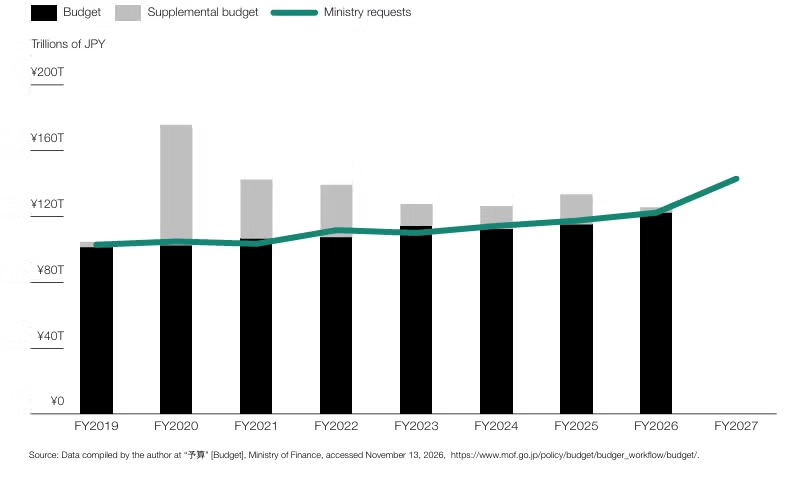
According to Riley Walters of the Hudson Institute, Japan’s Growth Strategy establishes targets to raise total gross domestic product (GDP) from ¥673 trillion in 2025 to ¥1.1 trillion by 2040 (rendered as ¥1.1 quadrillion in standard yen scale), push real GDP growth above 1%, and lift nominal GDP growth above 3%, while directing the Japanese government to prioritise 17 strategic sectors—including green transformation (GX) and artificial intelligence transformation (AX)—and setting funding priorities for artificial intelligence, robotics, critical minerals, and supply chain security. To advance these objectives, Tokyo seeks to double Japan’s annual flow of domestic private-sector capital investment to ¥250 trillion ($1.6 trillion) per year by 2040 by preparing a historic next-fiscal-year (FY2027) budget request of ¥143.1 trillion ($917.1 billion), including ¥12.2 trillion ($78.2 billion) allocated to the framework (about 9% of the initial ¥143.1 trillion request, roughly 17% above the prior year’s ¥122.4 trillion request, and excluding expected increases in defence spending ahead of National Diet action in March 2027).
How Is Prime Minister Sanae Takaichi Changing Japan’s Budgeting Process and Ministry Funding?
Reporting by Riley Walters of the Hudson Institute details how the administration of Prime Minister Sanae Takaichi—Japan’s first female prime minister—has structured FY2027 budget rules and ministry requests to avoid austerity constraints and prolonged budget negotiations:
- Avoiding Austerity and Budget Gridlock: As reported by Riley Walters of the Hudson Institute, Prime Minister Sanae Takaichi has argued since taking office that Japan requires a new growth strategy, viewing the economy as beginning to experience growth and seeking to avoid losing momentum to austerity measures or having her government tied down by budget negotiations—particularly as other economies with higher debt ratios than Japan’s pursue industrial policies.
- Special Account, Removed Ceilings, and Multi-Year Requests: Unlike earlier initiatives supporting domestic growth strategies, the Takaichi administration is funding the framework through a special account designed to preserve allocation flexibility and has abandoned a ceiling that previous governments maintained on budget requests, allowing ministries to raise annual funding requests for the initiative. Budget requests for the investment framework cover multi-year projects—enabling the government to bypass annual budget request cycles and gain predictability in coming years—while prioritising appropriations through the regular annual budget process rather than unpredictable supplementary budgets (such as FY2020 supplementary budgets that nearly matched the annual budget during the COVID-19 crisis).
- Ministry Allocations and Expected Defence Revisions: As reported by Riley Walters of the Hudson Institute, the total budget request could shift ahead of April 2027 as Japan updates its National Security Strategy, National Defense Strategy, and Defense Buildup Program—noting that a previous government in 2022 raised the defence budget by 100% over its initial request, while reports indicate the current government’s defence budget request could be as little as ¥60 trillion over five years, or ¥12 trillion per year. Meanwhile, the ¥12.2 trillion framework request reshapes departmental totals, with the Ministry of Economy, Trade, and Industry (METI) seeing the largest increase to a ¥5.7 trillion total request—up 450% from its ¥1 trillion annual base request—alongside expected benefits for the Ministry of Education, Culture, Sports, Science, and Technology (MEXT), the Ministry of Land, Infrastructure, Transport, and Tourism (MLIT), the Ministry of Health, Labor, and Welfare (MHLW), and the Digital Agency.
What Do Wages, Inflation, Bank of Japan Rates, and Tax Cuts Mean for Japan’s Economy?
Analysis by Riley Walters of the Hudson Institute examines how multi-decade economic shifts, supply shocks, monetary tightening, and tax policy intersect with the investment push:
- Growth Awakening, Wages, and Negative Real Wage Growth: After nominal GDP growth averaged 6% per year in the decade before 1991 before slowing to an average of just 1% per year since then, Japan’s economy has grown by an average of nearly 4% over the past five years, while shocks from the COVID-19 pandemic, Russia’s invasion of Ukraine, and US tensions with Iran have lifted energy and food prices and weakened Japan’s rigid wage structure—pushing contractual wages 12% higher in 2026 than in 2020. However, rising consumer prices continue to outpace nominal wage gains nationwide, keeping real wage growth negative, while producer prices are up more than 35% from 2020 amid long-standing reluctance among businesses—shaped by nearly 30 years of near-zero consumer price index growth—to pass higher costs on to consumers.
- Bank of Japan Policy Rates and Borrowing Costs: As reported by Riley Walters of the Hudson Institute, the Bank of Japan has cautiously raised policy rates incrementally—from -0.1% to 1.25% in September 2026—seeking to manage inflation risks without undermining growth momentum amid external conflicts, which directly affects the Takaichi government’s fiscal plans by raising borrowing costs.
- Food Consumption Tax Cut and Fiscal Position: Prime Minister Sanae Takaichi has led an effort to cut the consumption tax on food from roughly 8% to 1% for two years, prompting concern among lawmakers over fiscal health because the consumption tax supplies about 30% of annual tax revenue and cutting the food levy could reduce annual tax revenue by up to ¥4.3 trillion—with food consumption tax receipts accounting for roughly 4% of Japan’s approximately ¥84 trillion annual tax revenue, which could hold tax yield near 2025 levels without broader growth—even as the central government expenditure deficit has returned toward pre-COVID levels and moves toward a potential surplus within a few years despite large government debt (cited in the source text as ¥1.3 trillion as of September 2026).
How Do Key Figures and Policy Measures in Japan’s Fiscal Framework Compare?
A structured summary outlines the core metrics, targets, and policy parameters detailed in the report:
| Category / Indicator | Reported Figure or Policy Detail | Fiscal & Economic Context |
| GDP & Private Investment Targets | GDP from ¥673 trillion (2025) to ¥1.1 trillion (source text) by 2040; real growth >1%, nominal >3%; private investment to ¥250 trillion ($1.6tn)/yr | Anchored by Japan’s Growth Strategy and the Strong and Prosperous Japan Investment Framework launched in July 2026. |
| FY2027 Budget Request & Framework | ¥143.1 trillion ($917.1bn) initial request (+17% vs. ¥122.4tn prior year); ¥12.2 trillion ($78.2bn) for framework (~9% of initial request) | Excludes expected defence increases ahead of National Diet action in March 2027; METI request at ¥5.7 trillion (+450% vs. ¥1tn base). |
| Budgeting & Defence Outlook | Special account, removed request ceilings, multi-year projects; potential defence request around ¥60 trillion over 5 years (¥12tn/yr) | Shifts emphasis toward regular annual budgets over supplementary budgets and links to updated security/defence documents. |
| Wages, Prices & BOJ Rate | Contractual wages +12% vs. 2020; ~4% 5-year growth average; negative real wages; producer prices +35%+ vs. 2020; BOJ rate at 1.25% (Sept 2026) | Higher interest rates raise borrowing costs while consumer price rises outpace nominal pay. |
| Food Consumption Tax & Revenue | Food consumption tax cut proposed from ~8% to 1% for two years; up to ¥4.3 trillion annual revenue impact (~4% of ~¥84tn tax revenue) | Consumption tax provides ~30% of annual tax revenue; central expenditure deficit back near pre-COVID levels. |
Background of the Particular Development After the News
From the early 1990s until recent years, Japan experienced prolonged periods of sluggish nominal GDP expansion—averaging roughly 1% per year after 1991 compared with 6% annually in the prior decade—alongside subdued business and consumer sentiment and nearly three decades of near-zero consumer price inflation. Over the same span, Japan accumulated heavy public debt while relying periodically on large supplementary budgets during crises such as the COVID-19 pandemic in FY2020.
Against that backdrop, global supply-chain disruptions since 2020, shifting geopolitical tensions involving the United States, China, Russia, and Iran, and the arrival of Prime Minister Sanae Takaichi’s administration in office have prompted a pivot toward industrial policy, strategic investment across 17 sectors including green transformation (GX) and artificial intelligence transformation (AX), and budget process reforms aimed at attracting domestic and foreign capital.
How This Development Can Affect Japanese Households, Businesses, and International Partners
The Strong and Prosperous Japan Investment Framework, FY2027 budget proposals, and accompanying tax and monetary dynamics carry practical implications across key groups:
1. Japanese Households, Young Adults, and Fixed-Income Residents
For households, young adults, and residents on fixed incomes—who have experienced negative real wage growth even as contractual wages rose 12% since 2020—a two-year reduction in the food consumption tax from around 8% to 1% could ease grocery costs, while ongoing inflation and potential long-term price shifts require adjustment to higher living costs.
2. Domestic Companies, Strategic Sectors, and Ministries
For Japanese businesses and ministries such as METI, MEXT, MLIT, MHLW, and the Digital Agency, multi-year project budgeting, a special account, and expanded funding across GX, AX, robotics, critical minerals, and supply chain security can support long-term capital planning, even as rising interest rates increase borrowing costs and producer prices remain more than 35% above 2020 levels.
3. Foreign Investors and Strategic Allies Such as the United States
For overseas investors and international partners—including Washington—the framework’s push to double annual private-sector investment to ¥250 trillion ($1.6 trillion) by 2040 and expand strategic sector funding signals greater public backing for key industries, while defence budget levels relative to the ¥12.2 trillion framework and ¥12 trillion annual five-year defence figure remain a key point of scrutiny.