
Key Points
- Japan Airlines (TSE:9201) reported its half-year financial results for the six months ending 30 September 2026, combining an adjusted dividend plan and payout lift with detailed guidance on bond-type share distributions.
- First-half revenue reached ¥1.10 trillion, up 11.7 per cent year-on-year, while profit attributable to owners of the parent fell 42.2 per cent to ¥39.1 billion due to heavy fuel expenses and rising operational costs.
- The airline’s share price traded around ¥3,260 with a Price-to-Earnings (P/E) ratio of 13.4x, screening as undervalued relative to the broader Asian airlines industry average of 14.1x and peer group average of 26.9x.
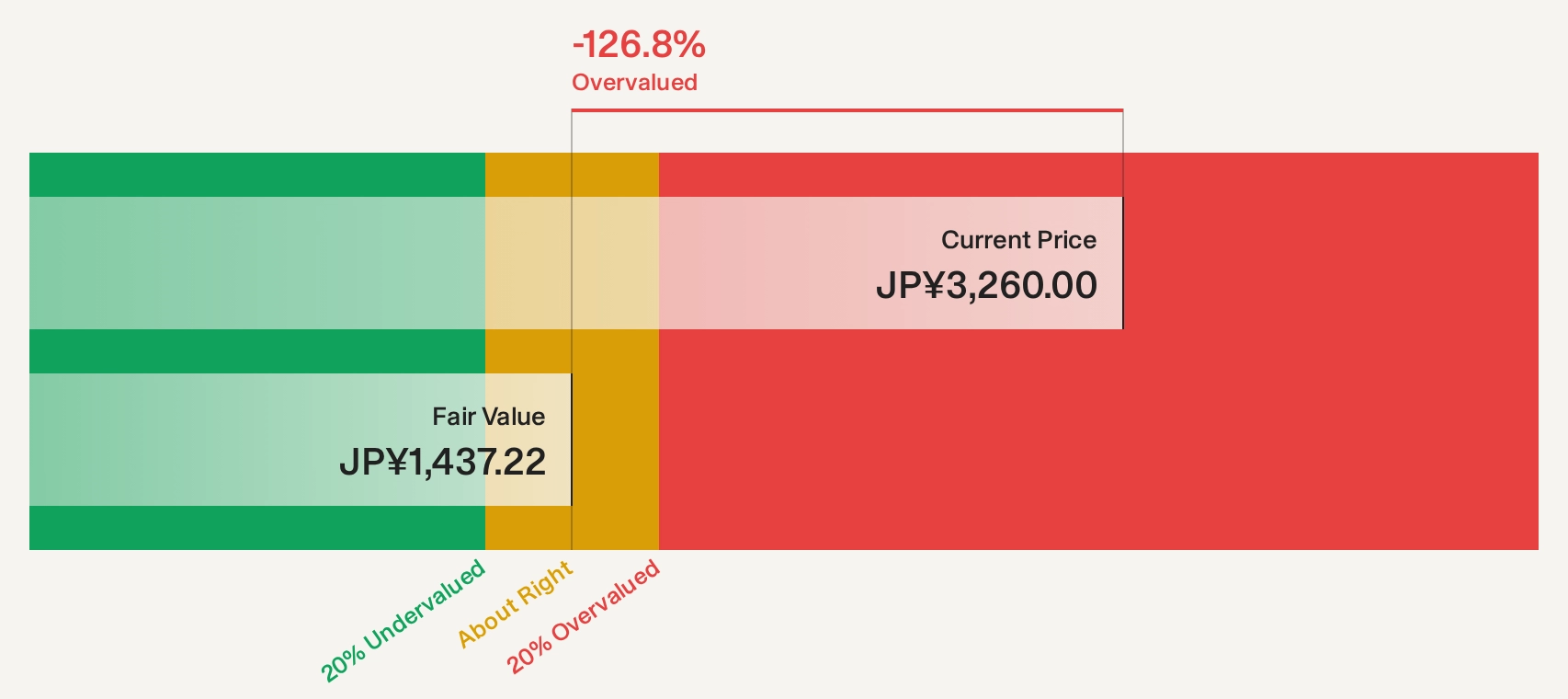
- A Discounted Cash Flow (DCF) model presents a divergent valuation signal, estimating future cash flow value at ¥1,437.22 per share, indicating potential overvaluation when viewed strictly through a cash flow lens.
- Full-year guidance for the fiscal year ending 31 March 2027 projects a profit attributable to owners of the parent of ¥110 billion on total revenue of ¥2.1 trillion.
Japan (Japan Daily News) November 6, 2026 – Japan Airlines Co., Ltd. (TSE:9201) has placed shareholder returns in sharp focus after releasing its financial results for the first half of the fiscal year ending 31 March 2027 and updating its dividend policy. According to financial disclosures released in Tokyo on Friday, 6 November 2026, the flag carrier announced an increase in its interim payout along with structured guidance regarding bond-type share distributions. Despite reporting an 11.7 per cent surge in top-line revenue to ¥1.10 trillion, net profit fell 42.2 per cent to ¥39.1 billion as elevated fuel costs and capital expenditures weighed on margins, prompting investors to weigh the carrier’s 13.4x earnings multiple against cash flow valuations.
- What Were the Key Financial Highlights in Japan Airlines’ Half-Year Results?
- Is Japan Airlines Stock Cheap at a 13.4x Price-to-Earnings Ratio?
- How Does the Discounted Cash Flow Valuation Compare to the P/E Snapshot?
- Background of the Particular Development After the News
- How This Development Can Affect Retail Investors, Airline Competitors, and Capital Markets
What Were the Key Financial Highlights in Japan Airlines’ Half-Year Results?
As reported by financial market correspondents at Alliance News and RTTNews, Japan Airlines Co., Ltd. (9201.T) delivered a mixed set of results for the six-month period ending 30 September 2026.
Total revenue for the first half of the fiscal year reached ¥1.10 trillion, representing an 11.7 per cent increase compared to the ¥985 billion recorded in the same period of the prior fiscal year. The revenue expansion was driven by sustained international passenger demand, pricing power across key long-haul routes, and non-aviation business growth.
However, net profit attributable to owners of the parent company declined 42.2 per cent year-on-year to ¥39.1 billion, down from ¥67.7 billion in the corresponding prior-year period. Earnings per share (EPS) for the half-year dropped to ¥79.91 from ¥150.11 a year earlier.
For the full fiscal year ending 31 March 2027, management reiterated its financial guidance, projecting a net profit attributable to owners of the parent of ¥110 billion and consolidated revenue of ¥2.1 trillion.
Is Japan Airlines Stock Cheap at a 13.4x Price-to-Earnings Ratio?
According to equity research analysts at Simply Wall St, Japan Airlines’ current trading price of approximately ¥3,260 places the stock on a Price-to-Earnings (P/E) multiple of 13.4x.
The 13.4x P/E ratio positions Japan Airlines as good value relative to regional industry benchmarks. The carrier trades below the broader Asian Airlines average P/E of 14.1x and significantly beneath its direct peer group average of 26.9x. Furthermore, financial modeling indicates an estimated fair P/E ratio of 18.9x, suggesting potential upside if earnings delivery aligns with market expectations.
The P/E metric links current market capitalisation to annual net earnings per share, helping market participants determine the premium required for each unit of airline profit. For a capital-intensive business subject to cyclical travel patterns, fuel price volatility, and heavy equipment maintenance, a lower earnings multiple provides management with operational leverage during turbulent market conditions.
How Does the Discounted Cash Flow Valuation Compare to the P/E Snapshot?
As detailed in financial valuation analyses by Simply Wall St, switching from an earnings-based metric to a Discounted Cash Flow (DCF) perspective yields a contrasting picture for prospective investors.
Under the SWS DCF model—which projects future free cash flows to the firm and discounts them back to present value using a calculated cost of capital—Japan Airlines at ¥3,260 trades above its estimated future cash flow fair value of ¥1,437.22 per share.
This divergence presents investors with two competing signals:
- Earnings Perspective: Undervalued based on a 13.4x P/E ratio relative to peer averages (26.9x) and an estimated fair P/E (18.9x).
- Cash Flow Perspective: Overvalued based on discounted future cash flows (estimated fair value of ¥1,437.22 versus the current market price of ¥3,260).
The discrepancy highlights the heavy capital expenditure requirements associated with fleet modernization, jet engine overhaul cycles, and debt servicing, which temporarily depress free cash flow metrics even when accounting earnings remain positive.
Background of the Particular Development After the News
The release of Japan Airlines’ first-half results comes during a period of structural realignment for the global aviation industry in Asia. Following the post-pandemic recovery in international inbound tourism to Japan, domestic carriers have faced dual pressure: strong passenger revenue growth on one hand, and rising jet fuel prices, weak yen exchange rates affecting foreign currency expenses, and labor shortages on the other. To optimize its capital structure and enhance shareholder returns, Japan Airlines has actively pursued balance sheet management, including the deployment of bond-type share classes and regular dividend payout reviews designed to reward long-term retail and institutional investors.
Concurrently, competition within domestic and regional Asian markets has intensified. Rivals such as ANA Holdings (TSE:9202) and regional low-cost carriers have expanded seat capacity across key East Asian transit corridors. In response, Japan Airlines has expanded non-aviation revenue streams—including its mileage loyalty program, cargo logistics, and hospitality ventures—to cushion core airline operations against sudden fluctuations in global fuel benchmark prices.
How This Development Can Affect Retail Investors, Airline Competitors, and Capital Markets
The adjusted dividend structure, earnings performance, and valuation signals published by Japan Airlines will generate distinct operational and investment outcomes across the transportation sector.
Impact on Retail and Institutional Equity Investors
For equity investors evaluating Japanese transport stocks, the combination of an increased dividend payout and a 13.4x P/E ratio provides income stability alongside value potential. However, the lower DCF fair value benchmark (¥1,437.22) serves as a warning sign for risk-averse investors concerned about capital expenditure drag and free cash flow generation. Investors seeking portfolio yield may view the stock’s recent price pullbacks as an entry point, provided the company achieves its full-year ¥110 billion profit target.
Impact on Airline Competitors and Regional Transport Aviation
For competing Asian carriers, Japan Airlines’ ability to maintain pricing power and absorb half-year profit declines while increasing shareholder distributions demonstrates baseline balance sheet resilience. Competitors like ANA Holdings will face continued pressure to match shareholder return initiatives, including dividend increases and capital allocation frameworks, to retain institutional capital within Japan’s transportation sector.
Impact on Corporate Debt and Hybrid Capital Markets
For fixed-income investors and capital markets underwriters, Japan Airlines’ detailed guidance on bond-type share distributions establishes a clear precedent for hybrid capital issuance among Japanese corporations. Utilizing specialized share classes allows the airline to raise capital for fleet updates while minimizing equity dilution for existing common shareholders, offering a flexible funding model for other industrial enterprises across the Tokyo Stock Exchange.