Key Points
- Bilateral Defense Agreement: Japan signed a 4.3 billion yen ($27 million) security framework agreement to transfer defense equipment to the Armed Forces of the Philippines.
- Equipment Breakdown: The security package allocates a coastal surveillance radar system to the Philippine Navy and uncrewed aerial vehicles (UAVs) to the Philippine Air Force.
- Milestone Equipment Transfer: This project represents the first official export of finished Japanese-made defense hardware under Tokyo’s Official Security Assistance (OSA) framework.
- Signatories and Location: The agreement was signed in Manila by Japanese Ambassador to the Philippines Katsuro Kitagawa and Philippine Foreign Secretary Theresa Lazaro.
- Broader Regional Diplomacy: Concurrently in Tokyo, Japanese Prime Minister Sanae Takaichi and Vietnamese President To Lam held bilateral talks, agreeing to accelerate defense assistance and reinforce a “free and open” Indo-Pacific.
Japan (Japan Daily News) November 09, 2026 – Japan agreed to provide a coastal surveillance radar system and uncrewed aerial vehicles to the Philippines on Monday under a 4.3 billion yen ($27 million) security assistance framework. The agreement was formally signed in Manila by Japanese Ambassador to the Philippines Katsuro Kitagawa and Philippine Foreign Secretary Theresa Lazaro. The initiative aims to strengthen maritime domain awareness and surveillance capabilities across critical sea lanes adjacent to the Philippines amidst regional maritime friction.
- How Will the Defense Equipment Be Allocated to the Philippine Military?
- What Is the Significance of Japan’s Official Security Assistance (OSA) Program?
- How Is Japan Expanding Its Broader Military Capabilities and Exports?
- What Other Security Agreements Were Made in Tokyo on the Same Day?
- What Current Tensions are Driving These Regional Security Moves?
- Background of the Defense Assistance Program
- How This Development Will Affect Regional Stakeholders?
How Will the Defense Equipment Be Allocated to the Philippine Military?
Under the terms detailed by the Ministry of Foreign Affairs of Japan, the hardware will directly enhance the operational capacity of two branches of the Armed Forces of the Philippines. As reported by the Associated Press, the coastal radar infrastructure is designated for installation by the Philippine Navy, while the uncrewed aerial vehicles will be integrated into the inventory of the Philippine Air Force.
The primary objective of the deployment is to heighten surveillance along strategically vital maritime corridors. The Japanese Foreign Ministry noted that the geographical location of the Philippines sits near critical global shipping channels, making robust maritime monitoring essential for regional security.
What Is the Significance of Japan’s Official Security Assistance (OSA) Program?
The 4.3 billion yen transaction marks a significant policy milestone for Japanese defense exports. As noted by the Associated Press, this agreement serves as the first transfer of finished, Japanese-manufactured defense equipment under Japan’s Official Security Assistance (OSA) program.
Established in 2023, the OSA framework was designed as a military-oriented counterpart to Tokyo’s traditional Official Development Assistance (ODA) program. The strategic framework focuses on delivering grant aid to like-minded developing nations, primarily to bolster their defense infrastructure and capability to respond to security challenges linked to China’s expanding influence in the Indo-Pacific region.
How Is Japan Expanding Its Broader Military Capabilities and Exports?
This equipment deal reflects Japan’s broader shift toward an accelerated military setup and arms industry growth. Japanese authorities previously lifted long-standing self-imposed restrictions on lethal weapons exports, opening avenues for expanded international security partnerships.
Beyond the current radar and drone deal, Tokyo and Manila have initiated discussions regarding a bilateral arrangement that could allow Japan to transfer decommissioned destroyers to the Philippine Navy. These moves highlight Tokyo’s intent to build durable defense-industrial partnerships across Southeast Asia.
What Other Security Agreements Were Made in Tokyo on the Same Day?
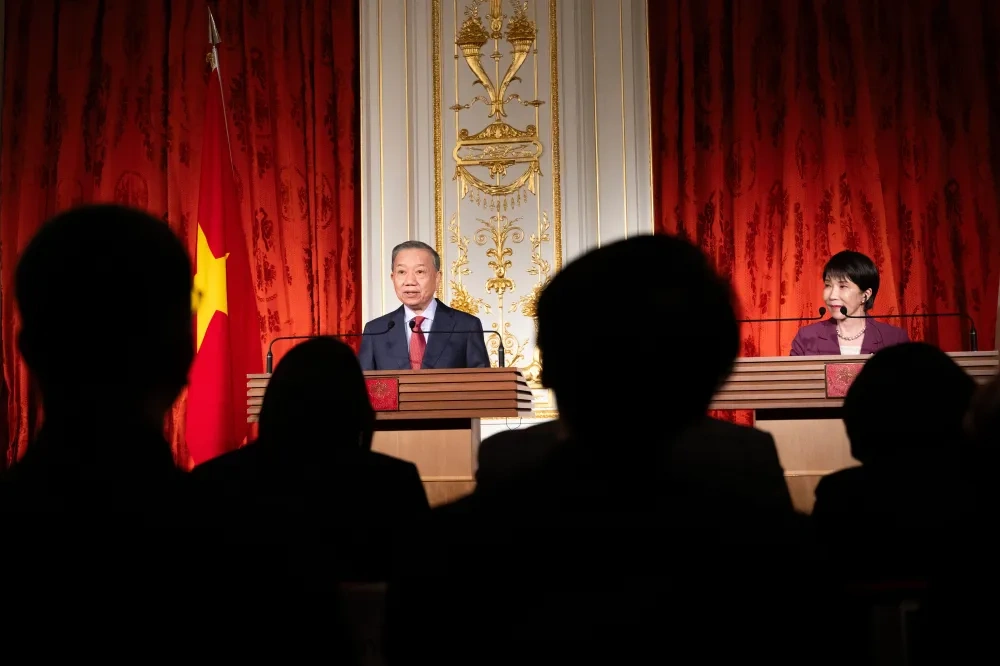
Parallel to the signing in Manila, high-level diplomatic talks took place in Tokyo between Japanese Prime Minister Sanae Takaichi and Vietnamese President To Lam. The two leaders held a joint press conference following bilateral discussions, where they pledged to deepen cooperation spanning defense, energy, and economic security.
During the conference, Prime Minister Sanae Takaichi announced that Japan would accelerate planned security assistance to Vietnam to support its involvement in international peacekeeping missions. Furthermore, Takaichi and President Lam affirmed a shared commitment to maintaining a rules-based, “free and open” Indo-Pacific order. The bilateral summit concluded with the signing of several agreements covering nuclear energy development, gas-fired power generation, semiconductors, and artificial intelligence technology.
What Current Tensions are Driving These Regional Security Moves?
The defense pacts come against a backdrop of security concerns in the South China Sea and East China Sea. Beijing holds expansive territorial claims in the South China Sea that overlap with the exclusive economic zones of the Philippines and Vietnam. These maritime disputes have led to repeated standoffs, collisions involving naval and coast guard vessels, and injuries to maritime personnel.
Simultaneously, Japan faces sustained maritime pressure along its own periphery. Chinese coast guard vessels and military aircraft regularly operate near Japanese-controlled, uninhabited islands in the East China Sea, known as the Senkaku Islands in Japan and the Diaoyu Islands in China, over which Beijing asserts sovereignty.
(Reporting contributed by Associated Press video journalist Hau Dinh in Hanoi, Vietnam.)
Background of the Defense Assistance Program
Japan’s Official Security Assistance (OSA) framework was formally introduced by Tokyo in April 2023 as part of its updated National Security Strategy. Historically, Japan constrained its foreign assistance strictly to non-military development through Official Development Assistance (ODA) due to post-World War II constitutional parameters. However, changing geopolitical conditions in East Asia prompted Tokyo to establish the OSA to directly grant military hardware, communication systems, and surveillance technology to regional partners.
The Philippines was among the earliest designated recipients under the OSA framework. Prior to the November 2026 announcement regarding completed equipment transfers, initial phases of cooperation focused on domain awareness infrastructure, search-and-rescue assets, and joint military training exercises. Tokyo’s defense export posture was further revised when Japan removed key restrictions on lethal equipment transfers, allowing it to export completed items manufactured under license and explore direct military transfers to foreign armed forces.
How This Development Will Affect Regional Stakeholders?
Impact on the Armed Forces of the Philippines and Defense Analysts
The acquisition of Japanese-made coastal radar systems and uncrewed aerial vehicles will improve the Philippine military’s real-time maritime domain awareness. For defense planners in Manila, integrating these assets into the Philippine Navy and Air Force enables continuous surveillance of key sea lines of communication, specifically within the Luzon Strait and areas adjacent to the South China Sea. This capability reduces blind spots in maritime tracking and allows the Armed Forces of the Philippines to monitor vessel traffic and respond more effectively to maritime incidents.
Impact on Regional Maritime Security and Indo-Pacific Partners
For Japan and its security allies, including the United States, Australia, and ASEAN partners, this transfer sets a practical precedent for defense hardware collaboration under the OSA framework. The integration of defense equipment across like-minded states strengthens regional deterrence structures aimed at keeping critical maritime lanes open and regulated under international law. Over the medium to long term, additional agreements—such as the potential transfer of naval destroyers—could establish Japan as a main defense equipment provider in Southeast Asia.