Key Points
- Oil prices have recently rebounded due to ongoing anxieties surrounding Middle East supply chains, keeping global energy costs tightly in focus for Japanese households and corporate sectors.
- Rising input expenses continue to exert pressure on weaker business entities, pushing market investors to hunt for enterprises possessing resilient balance sheets and clear prospects for earnings expansion.
- Sansan (TSE:4443) is aligned with the healthy high-growth theme, backed by expectations that annual earnings will climb by roughly 23.39% as its cloud-based contact-management platform and related SaaS solutions scale across Japanese enterprises.
- Micronics Japan (TSE:6871) fits the high-growth profile via semiconductor probe cards and wafer probers tied directly to the chip production ramp, driving a forecast 24.88% annual earnings expansion alongside 23% revenue growth.
- freee K.K (TSE:4478) integrates into the growth theme through subscription-based cloud accounting, HR, and labor tools tailored for Japanese small and mid-sized businesses (SMBs), while navigating underlying profitability tensions.
- Market analysts note that alternative avenues—such as solid balance sheet lists, income-focused dividend fortresses, and AI infrastructure pools—offer varied risk mitigation strategies amid changing macroeconomic sentiment.
Japan (Japan Daily News) November 4, 2026 – As rebounding international oil prices driven by persistent Middle East supply worries thrust energy costs back into the spotlight, Japanese market participants are increasingly scrutinizing corporate resilience. Rising input expenses threaten to squeeze vulnerable commercial entities, prompting capital flows toward firms with robust balance sheets and transparent earnings expansion potential. Analysts tracking regional markets have turned their attention toward selected equities that align with health-focused high-growth themes. Among these, cloud software provider Sansan, semiconductor equipment manufacturer Micronics Japan, and enterprise SaaS platform provider freee K.K. have emerged as focal points for investors navigating the shifting economic landscape of late 2026.
- How Are Macroeconomic Pressures and Energy Costs Shaping the Japanese Growth Stock Environment?
- What Drives the Growth Outlook for Sansan (TSE:4443)?
- How Is Micronics Japan (TSE:6871) Capitalizing on the Semiconductor Demand Ramp?
- What Role Does freee K.K (TSE:4478) Play in the Japanese SMB Cloud Ecosystem?
- Where Else Are Investors Looking to Mitigate Volatility and Find Alternatives?
- Background of the Development
- How This Development Can Affect Investors and Japanese Enterprises
How Are Macroeconomic Pressures and Energy Costs Shaping the Japanese Growth Stock Environment?
Global energy market fluctuations, triggered by renewed tensions in the Middle East, have cascaded down to corporate balance sheets across East Asia. According to market analyses, escalating energy costs act as a strict filter for corporate strength, magnifying the vulnerabilities of firms with high overheads while rewarding those boasting scalable business models and strong liquidity positions.
As stated in market commentary, rising input costs can pressure weaker firms, which pushes investors to look for businesses with resilient balance sheets and clear earnings expansion potential. Within this environment, market observers have evaluated a curated list of Japanese growth candidates that meet stringent financial health and earnings criteria. While numerous options exist across broader equity markets, three specific entities—Sansan, Micronics Japan, and freee K.K.—have drawn targeted attention for their distinct operational footprints.
What Drives the Growth Outlook for Sansan (TSE:4443)?
Operating primarily within the domestic market, Sansan provides specialized cloud software designed to help Japanese businesses manage and share contact, invoice, and contract data to support more efficient sales growth. According to financial operational breakdowns, Sansan generates approximately ¥48.9 billion from its core Sansan and Bill One segments, ¥7.1 billion from Eight, and ¥0.4 billion from other operations, accumulating a total revenue base of ¥56.2 billion against a market capitalization of ¥268.0 billion.
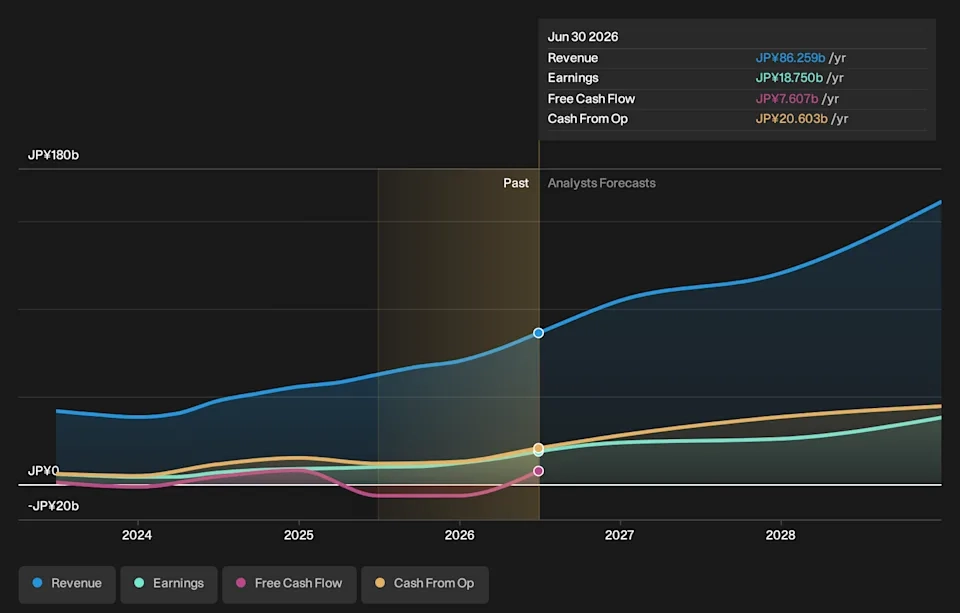
Market analysts note that Sansan is closely aligned with the healthy high-growth potential theme, with projections indicating that earnings could climb by approximately 23.39% annually. This trajectory is supported by the ongoing scaling of its contact-management platform and related Software-as-a-Service (SaaS) tools across Japanese enterprises. Furthermore, the company exhibits improving profitability metrics and a high forecast Return on Equity (ROE). However, financial experts caution that future returns remain contingent upon how long-term demand pressures for its core services ultimately resolve, making a careful review of its underlying risk factors essential for prospective investors.
How Is Micronics Japan (TSE:6871) Capitalizing on the Semiconductor Demand Ramp?
Shifting from enterprise software to high-tech hardware, Micronics Japan develops and sells specialized semiconductor probe cards, wafer probers, and related testing equipment, alongside niche body-measuring and display inspection tools. Operational data indicates that the company generates roughly ¥84.9 billion from its Probe Card Business and ¥1.4 billion from its TE Business, conducting operations largely across Asian markets and the United States.
Industry reports highlight that Micronics Japan fits squarely within the healthy high-growth potential theme. Its probe cards and semiconductor test tools are tied directly to the broader chip production ramp, which underpins a forecast 23% revenue growth rate and a 24.88% yearly earnings expansion. These upward trends are reportedly reinforced by recent H1 2026 profit acceleration and a sharply higher dividend payout. Nonetheless, analysts point out that these dynamics are heavily influenced by the resolution of underlying memory semiconductor demand variables, underscoring the importance of monitoring specific warning signs before momentum shifts.
What Role Does freee K.K (TSE:4478) Play in the Japanese SMB Cloud Ecosystem?
Targeting the backbone of the domestic corporate structure, freee K.K. offers cloud-based accounting, human resources, sales, tax, and related software solutions that assist Japanese small and mid-sized businesses (SMBs) in managing daily administrative and operational workflows. Financial disclosures show that the company generates approximately ¥42.4 billion entirely from its Platform Business segment within Japan, underpinned by a market capitalization of ¥275.4 billion.
freee K.K. ties cleanly into the healthy high-growth potential theme through subscription-driven tools such as freee Accounting and freee HR & Labor. While subscription retention models provide predictable revenue streams, the company’s trajectory leaves significant weight riding on how internal profitability tensions resolve. Market commentators emphasize that examining the firm’s key rewards and warning signs is critical for determining whether its operational results will transition from steady grinding to accelerated expansion.
Where Else Are Investors Looking to Mitigate Volatility and Find Alternatives?
Beyond the primary trio of growth stocks, market strategists emphasize the importance of scanning alternative asset pools to manage risk amid fluctuating sentiment. Fresh ideas often capture early movements before mainstream market participation crowds the trade.
Analysts suggest exploring curated lists featuring companies with solid balance sheets and robust fundamentals—comprising over 20 evaluated results—to filter out financially weaker businesses. For income-oriented investors prioritizing cash flow while yields remain elevated, hand-picked sets of dividend fortresses provide alternative defensive positioning. Additionally, tracking infrastructure players within focused pools of artificial intelligence (AI) infrastructure stocks allows participants to observe the foundational build-out behind ongoing tech momentum before broader market attention shifts.
Background of the Development
The heightened focus on Japanese growth equities in November 2026 emerges against a complex backdrop of macroeconomic recalibration. Throughout late 2025 and 2026, global supply chain instabilities, fluctuating commodity markets, and renewed geopolitical volatility in the Middle East have directly impacted energy pricing and input costs across industrialized nations, including Japan. As imported energy expenses weigh on corporate margins, traditional valuation metrics have undergone rigorous re-evaluation.
Concurrently, Japan’s domestic corporate sector has experienced an accelerated push toward digital transformation, cloud adoption, and semiconductor manufacturing investments, driven by structural labor shortages and government-backed tech initiatives. In response to these dual pressures—soaring operational costs on one side and digital efficiency demands on the other—financial analysts and market platforms have systematically filtered Japanese equities to identify firms possessing scalable SaaS business models, specialized hardware niches, and resilient balance sheets capable of weathering macroeconomic headwinds.
How This Development Can Affect Investors and Japanese Enterprises
This ongoing market focus on energy-resilient, high-growth Japanese equities is expected to significantly influence local corporate financing and retail investment strategies. For Japanese enterprises, particularly small and mid-sized businesses adopting platforms like freee K.K. or enterprise tools like Sansan, the pressure to optimize operational efficiency through cloud software will likely intensify as companies seek to offset rising input and energy costs through automation.
For retail and institutional investors, this scrutiny encourages a more disciplined, selective approach to portfolio allocation. Rather than broad market indexing, capital is increasingly concentrated in firms demonstrating high forecast ROE, transparent earnings expansion, and strong cash flow generation. However, this dynamic also heightens vulnerability to sector-specific shocks; any unexpected slowdown in memory semiconductor demand or corporate IT spending could trigger sharp valuation corrections in high-multiple growth stocks like Micronics Japan and Sansan. Consequently, investors are urged to balance high-growth exposure with defensive dividend assets and solid balance-sheet fundamentals to safeguard against broader market volatility.